
Mem0 Vector Graph Memory Architecture Explained

Let me ask you something honestly — have you ever built an AI agent that seemed brilliant on day one, only to watch it turn into a goldfish by session three? You chat with it, it helps you debug a gnarly function, you close the tab, come back tomorrow, and… nothing. It doesn’t remember you switched to ClickHouse. It doesn’t remember you hate verbose variable names. It greets you like a stranger.
That’s not intelligence — that’s a very expensive autocomplete.
This is the memory problem every LLM engineer hits eventually, and it’s exactly the problem that Mem0’s vector graph memory architecture was designed to solve. Not paper-over, not hack around — actually solve, with a proper dual-storage engine that combines the best of vector search and knowledge graphs. In this guide, we’ll break down exactly how it works, why it beats naive RAG, and how you can wire it into your own agent today.
Why RAG and Context Injection Fall Short
The Context Window Problem
The default approach most teams reach for is simple: just keep appending turns to the prompt. Session 1, 10 turns — fine. Session 10, 500 turns — suddenly you’re burning significant money per query and your p95 latency has crawled past 17 seconds. That’s the real-world reality of full-context history injection at scale, measured on the LOCOMO benchmark (Chhikara et al., ECAI 2025), which tested systems across 1,540 questions over extended multi-session dialogues.
But cost and latency are only the visible tax. The hidden one is quality. Attention doesn’t degrade gracefully as context grows. Models consistently perform worse on facts buried in the middle of a long context — the well-documented lost-in-the-middle effect. You can throw a 200K-token context window at the problem, but you cannot throw attention quality at it. More tokens does not equal better memory.
Why Vector Embeddings Alone Are Not Enough
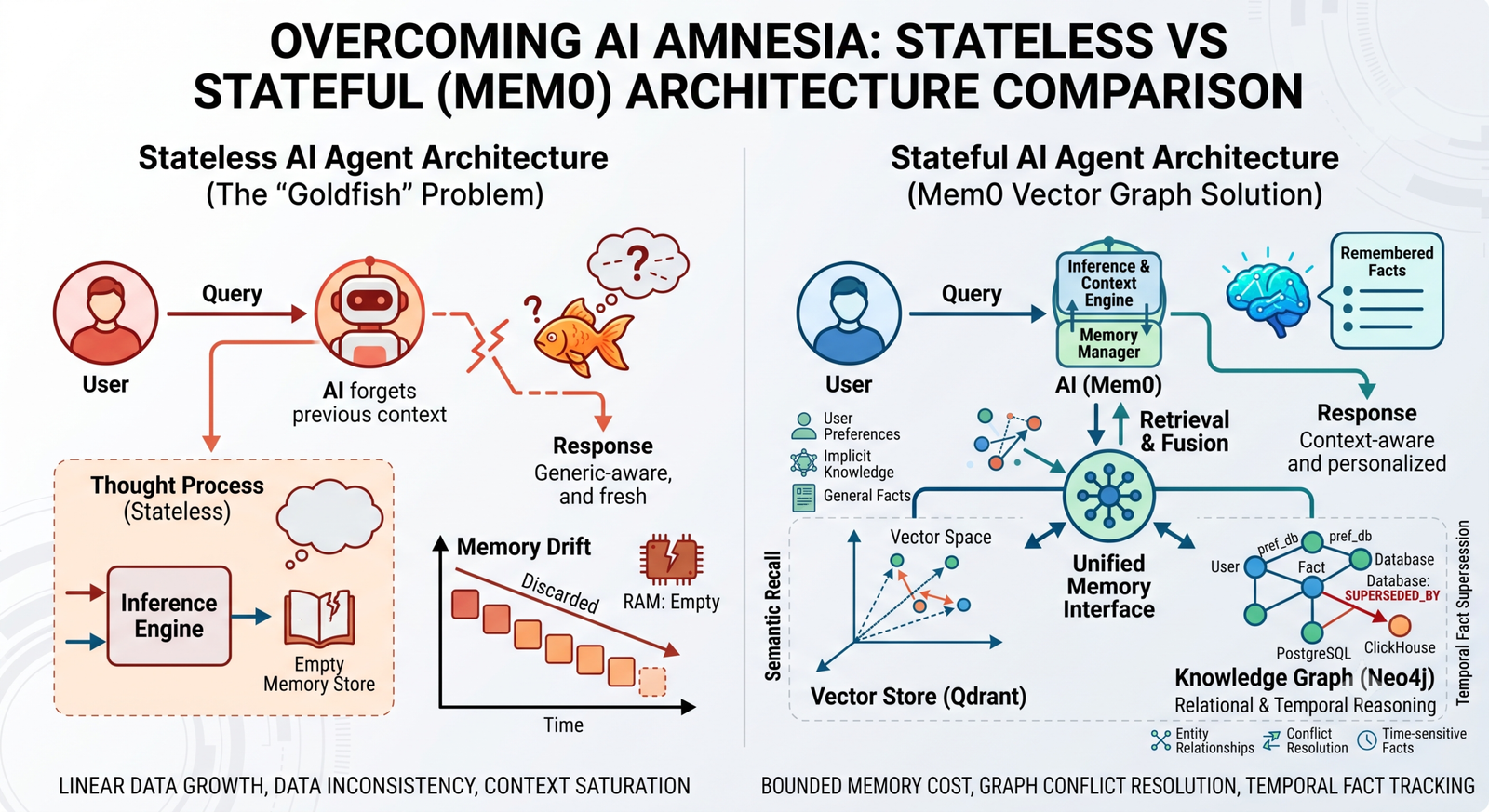
Standard RAG is a step forward — instead of pasting the full transcript, you embed it, store it in a vector DB, and retrieve the top-k relevant chunks at query time. Works well for static documents. Falls apart for conversational state.
Here’s the concrete failure: imagine a developer tells their agent “we’re moving from PostgreSQL to ClickHouse.” Your embedding model will store both the old fact and the new fact at nearly identical points in vector space — they share subject, predicate, and domain vocabulary. A cosine similarity search will happily return both. Your downstream LLM has to guess which is current. It can’t — not reliably, not consistently.
And that’s before we get to relational queries. “Which services still depend on the database we deprecated?” is a graph traversal, not a nearest-neighbor lookup. No amount of tuning your embedding model or increasing your top-k budget fixes that. That structural gap is the entire reason a hybrid vector-graph memory layer exists.
What Is Mem0’s Vector Graph Memory Architecture?
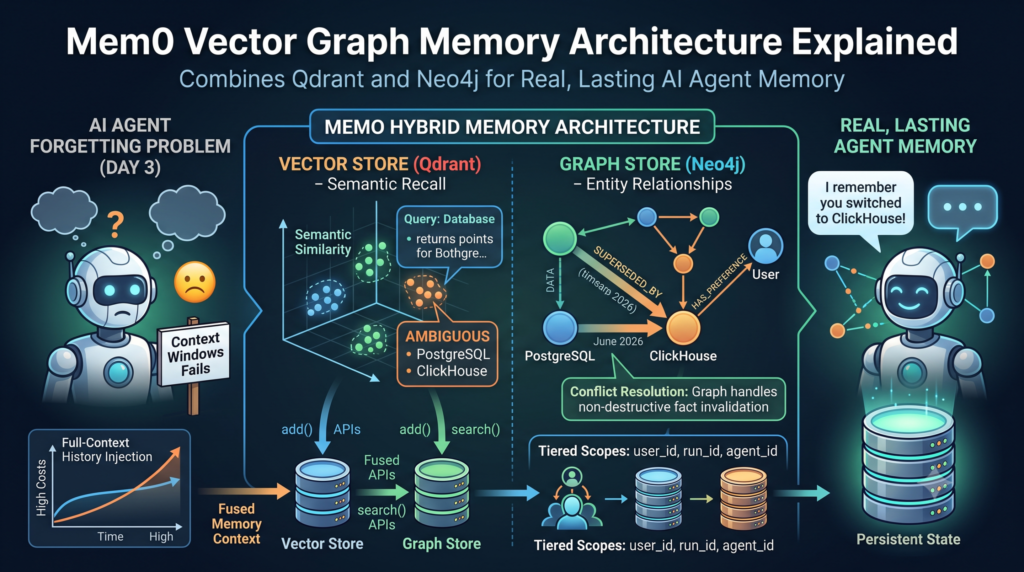
At its core, Mem0’s vector graph memory architecture is a dual-storage system that routes different types of memory to the engine best suited to handle it. Semantic similarity queries — preferences, working style, general facts — go to a vector index. Relational, entity-level, time-sensitive facts — who depends on what, what changed and when — go to a knowledge graph. The system manages the routing automatically behind a unified add() and search() API.
Think of it like your own brain: you don’t consciously file a memory under “episodic” or “semantic” — you just remember. Mem0 does the same thing for your agent, except instead of neurons, it uses Qdrant and Neo4j.
The Three-Tier Memory Partitioning
Every memory in Mem0 is scoped along three axes. Understanding these is critical before you write a single line of code — get the partitioning wrong and you’ll have agents leaking context into each other:
user_id— Persists across all sessions for one person. Stores durable preferences, long-term facts, working style. This is the “who is this person?” layer.run_id— Scoped to a single session or task run. Scratch context that should not bleed into the user’s permanent profile. When the session ends, it stays contained.agent_id— Memory owned by a specific agent persona. Critical in multi-agent systems — your SQL agent and your UI agent should not silently share operational context, and this scope boundary enforces that cleanly.
These three scopes compose. You can query “this user, this agent, any run” or “this user, this specific run only” — filtering at retrieval time is sub-millisecond and prevents the cross-contamination that quietly breaks production multi-agent setups.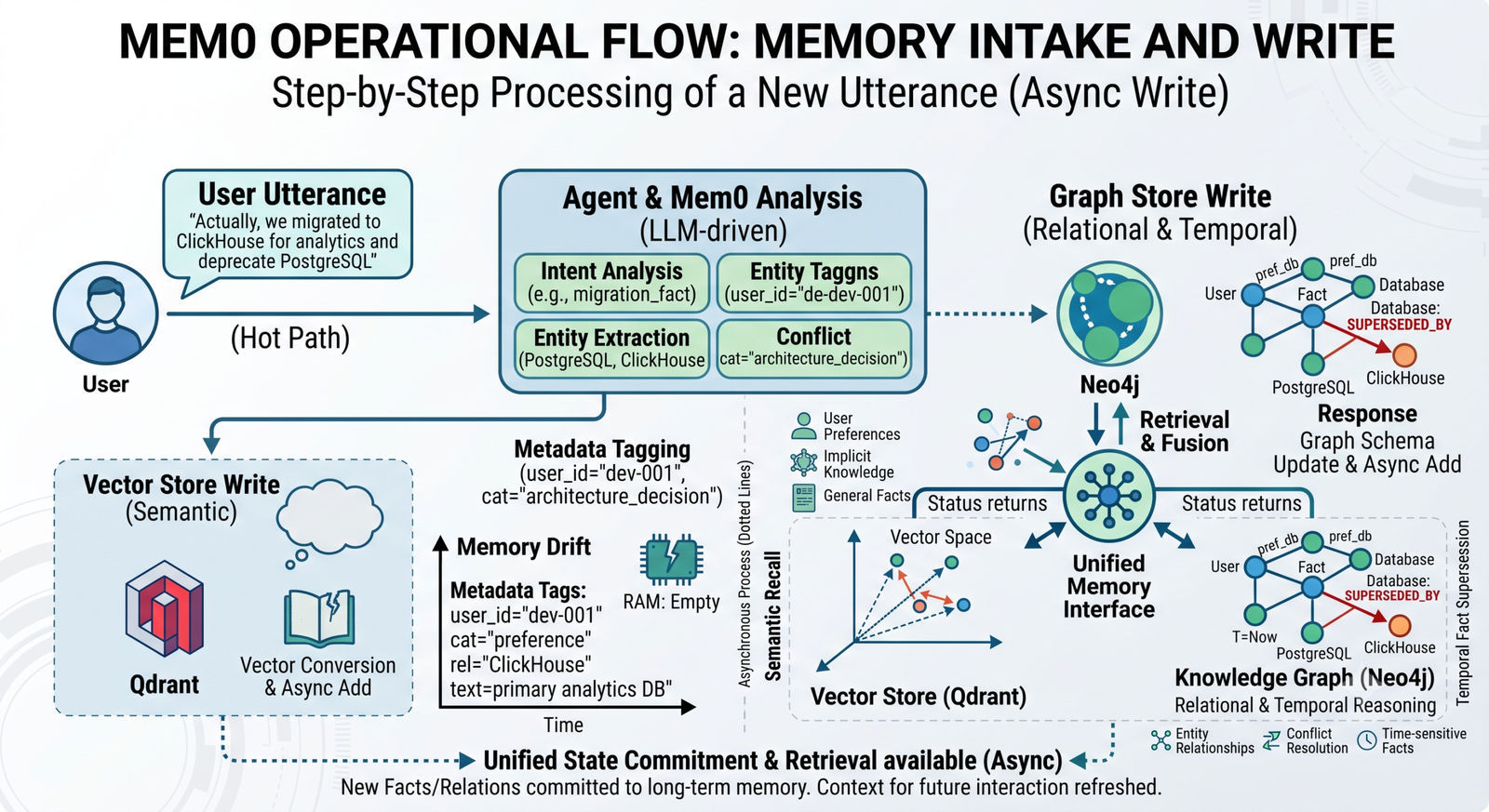
The Dual Storage Engine: Qdrant + Neo4j
Vector Store with Qdrant
Every add() call lands in the vector store by default. Qdrant is the reference backend, but Mem0 ships adapters for Chroma, Milvus, PGVector, Pinecone, and Weaviate — swapping backends is a single config-key change, no rewrite required. This is where semantic recall lives. “What does this user prefer?” is a similarity search. It’s fast, cheap, and scales horizontally.
The vector store is your agent’s intuition layer — fuzzy, associative, probabilistic. It’s excellent at “what’s roughly relevant to this query?” and genuinely poor at “is this fact still current, and what does it depend on?”
Graph Store with Neo4j
The graph layer is opt-in, backed by Neo4j, and this is where Mem0’s vector graph memory architecture earns its name. When you enable graph memory, entities become nodes and relationships become directed, labeled edges. Here is what that concretely buys you:
- Non-destructive fact invalidation — When a user switches from PostgreSQL to ClickHouse, Mem0 does not delete the old fact. It adds a
SUPERSEDED_BYedge from the old node to the new one. The history is preserved for audit; retrieval ranking suppresses the stale version via a recency decay penalty. Hard-deletion is a data-loss decision made at write time under uncertainty; graph invalidation is a display decision made at read time with full information — and it’s reversible. - Multi-hop relationship queries — “Which services depend on the deprecated database?” is a graph traversal that vector search structurally cannot answer. Neo4j handles it in milliseconds with Cypher.
- Full provenance and audit trail — Every edge is timestamped. You can ask “when did the user first mention this entity?” and get a real answer, not a hallucinated one.
One honest caveat: graph memory roughly doubles average per-query token footprint and adds 100–300ms of multi-hop latency. Enable it selectively — reserve it for relationship-dense domains like service-dependency maps, org charts, or architectural decision tracking. For flat preference storage, the vector layer is enough and cheaper.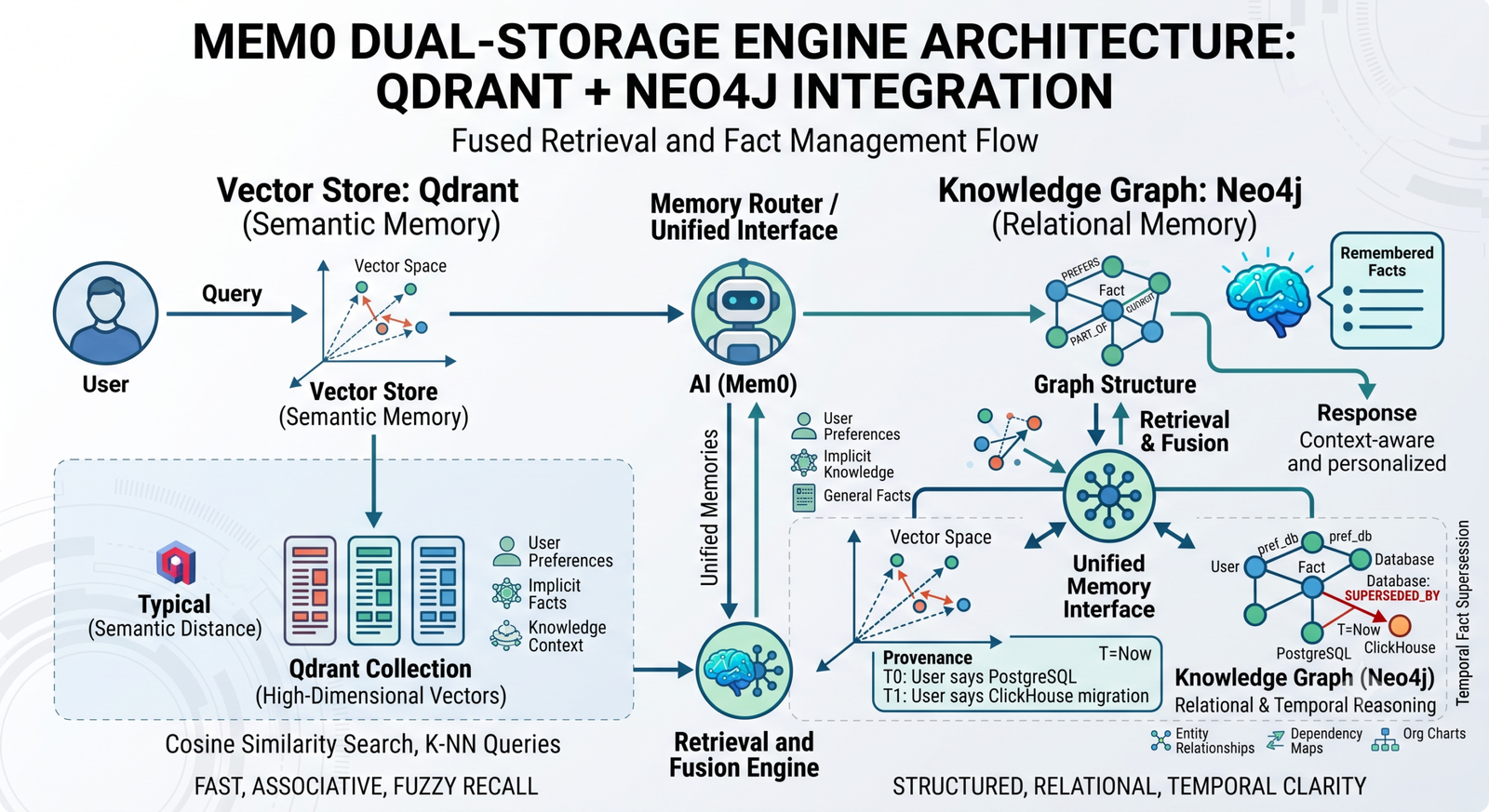
How to Add Graph Memory to AI Agents with Mem0
Mem0 Qdrant Neo4j Memory Setup Tutorial
Here’s a working example that initializes Mem0 with both storage engines and demonstrates async add and search. First, install the dependencies:
pip install mem0ai qdrant-client neo4jThen configure and initialize the memory client:
from mem0 import AsyncMemory
from mem0.configs.base import MemoryConfig

config = MemoryConfig(
    llm={
        "provider": "openai",
        "config": {"model": "gpt-4o-mini", "temperature": 0.0},
    },
    embedder={
        "provider": "openai",
        "config": {"model": "text-embedding-3-small"},
    },
    vector_store={
        "provider": "qdrant",
        "config": {
            "collection_name": "agent_memory",
            "host": "localhost",
            "port": 6333,
            "embedding_model_dims": 1536,
        },
    },
    graph_store={
        "provider": "neo4j",
        "config": {
            "url": "bolt://localhost:7687",
            "username": "neo4j",
            "password": "your-password",
            "database": "neo4j",
        },
    },
)

memory = AsyncMemory(config=config)
Writing a memory (always fire this off the hot path — after the response is sent):
await memory.add(
    "User prefers ClickHouse over PostgreSQL for analytics workloads",
    user_id="dev-001",
    agent_id="copilot",
    metadata={"category": "architecture_decision"},
)

# Searching with a metadata filter
results = await memory.search(
    "what database does this user prefer?",
    user_id="dev-001",
    agent_id="copilot",
    filters={"category": "architecture_decision"},
    limit=5,
)

for r in results["results"]:
    print(r["memory"])
Critical production note: add() runs an LLM extraction call internally and typically adds 200–400ms of write latency. Always fire it after the response has been streamed back to the user — never block the response path waiting for it. This single sequencing mistake is responsible for most of the “Mem0 is slow” complaints you’ll see in forums.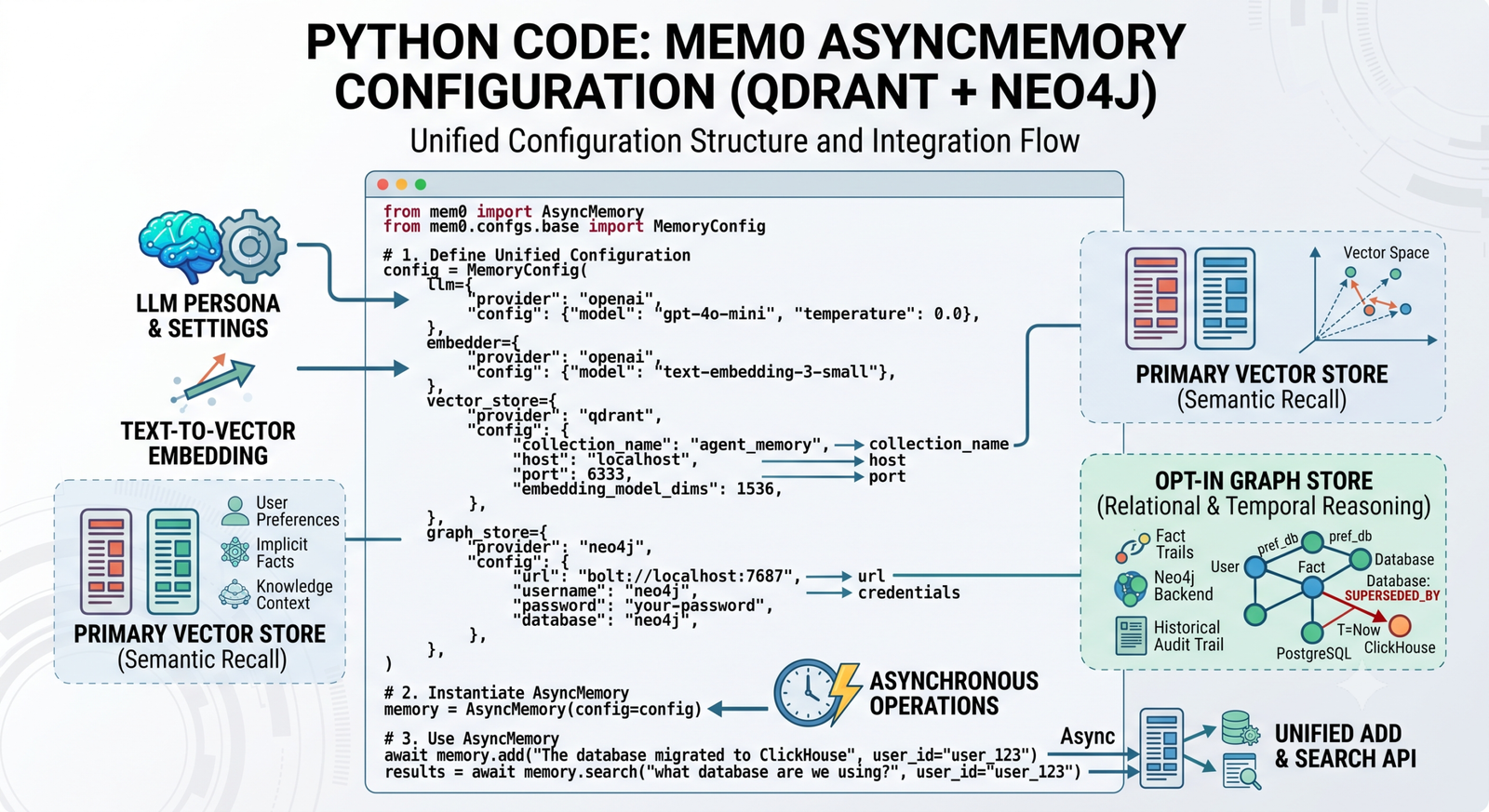
Graph Memory vs Vector Memory for LLM Agents
Not sure which storage layer your agent actually needs? This breakdown will save you hours of trial and error:
| Feature | Vector Only (Qdrant) | Graph Only (Neo4j) | Mem0 Hybrid (Both) |
|---|---|---|---|
| Best for | User preferences, general facts, semantic recall | Entity relationships, dependency maps, org charts | Complex agents needing both recall and structured reasoning |
| Fact invalidation | Returns both old and new facts — LLM must guess | SUPERSEDED_BY edge — stale facts ranked lower automatically | Graph handles contradiction; vector handles semantic recall |
| Query type | Nearest-neighbor (cosine similarity) | Graph traversal (Cypher queries) | Fused: cosine + BM25 + entity overlap + recency decay |
| Avg. tokens per query | ~1,800 tokens | ~3,500–4,000 tokens | ~2,000–4,500 tokens (config-dependent) |
| vs Full-context injection | ~90% token reduction | ~85% token reduction | ~85–90% reduction with higher accuracy on relational queries |
| Historical audit trail | No — updates overwrite | Yes — full edge history preserved | Yes — complete provenance via graph layer |
| Setup complexity | Low — Qdrant only | Medium — Neo4j instance required | Medium-High — Qdrant + Neo4j both required |
| p95 query latency | ~1.4 seconds | ~1.8–2.2 seconds (graph traversal) | ~1.4–2.5 seconds (depends on hop depth) |

Real-World Use Cases and My Experience
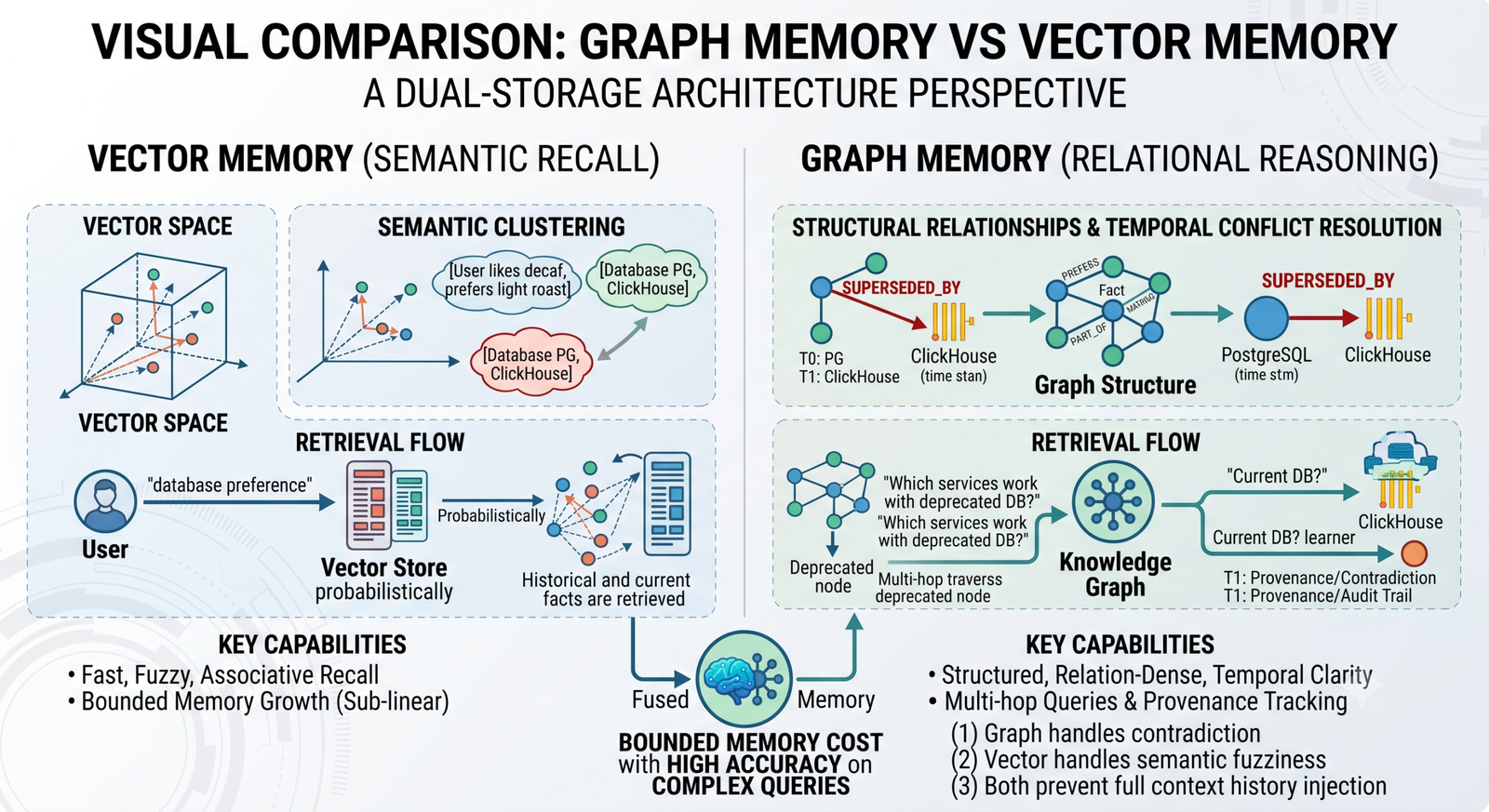
I’ve tested Mem0’s vector graph memory architecture across several real agent builds, and the capability that consistently surprises people is temporal reasoning — not just “remember this,” but “remember that this changed, and know which version is current.”
One concrete example: a codebase copilot tracking architectural decisions. The developer said early in the project, “our primary datastore is PostgreSQL.” Three months later: “we migrated to ClickHouse for analytics.” With pure vector memory, both facts coexist in equal standing. A query returns both and the LLM has to guess. With graph memory enabled, Mem0 automatically writes a SUPERSEDED_BY edge, and when you ask “what database do we use?”, it surfaces ClickHouse with confidence — not PostgreSQL, not both. That’s not magic. That’s a well-designed conflict-resolution algorithm doing exactly what you’d want a human engineer to do.
The second pattern that impressed me was multi-agent isolation. Two agents sharing one user_id but different agent_ids — a research agent and a writing agent — correctly scoped their operational memories without any cross-contamination. The research agent’s scratchpad did not leak into the writer’s style preferences. That kind of boundary is easy to violate and extremely hard to debug after the fact in a multi-agent production system.
The third pattern worth highlighting: the AI agent memory layer stays flat in token cost regardless of how long the conversation history grows. At 10 turns, you’re retrieving ~2,000 tokens of relevant context. At 500 turns, you’re still retrieving ~2,000 tokens of relevant context — Mem0’s retrieval returns a bounded top-k, growing sub-linearly with total memory store size, not linearly with conversation length. That’s the architectural argument that matters at production scale.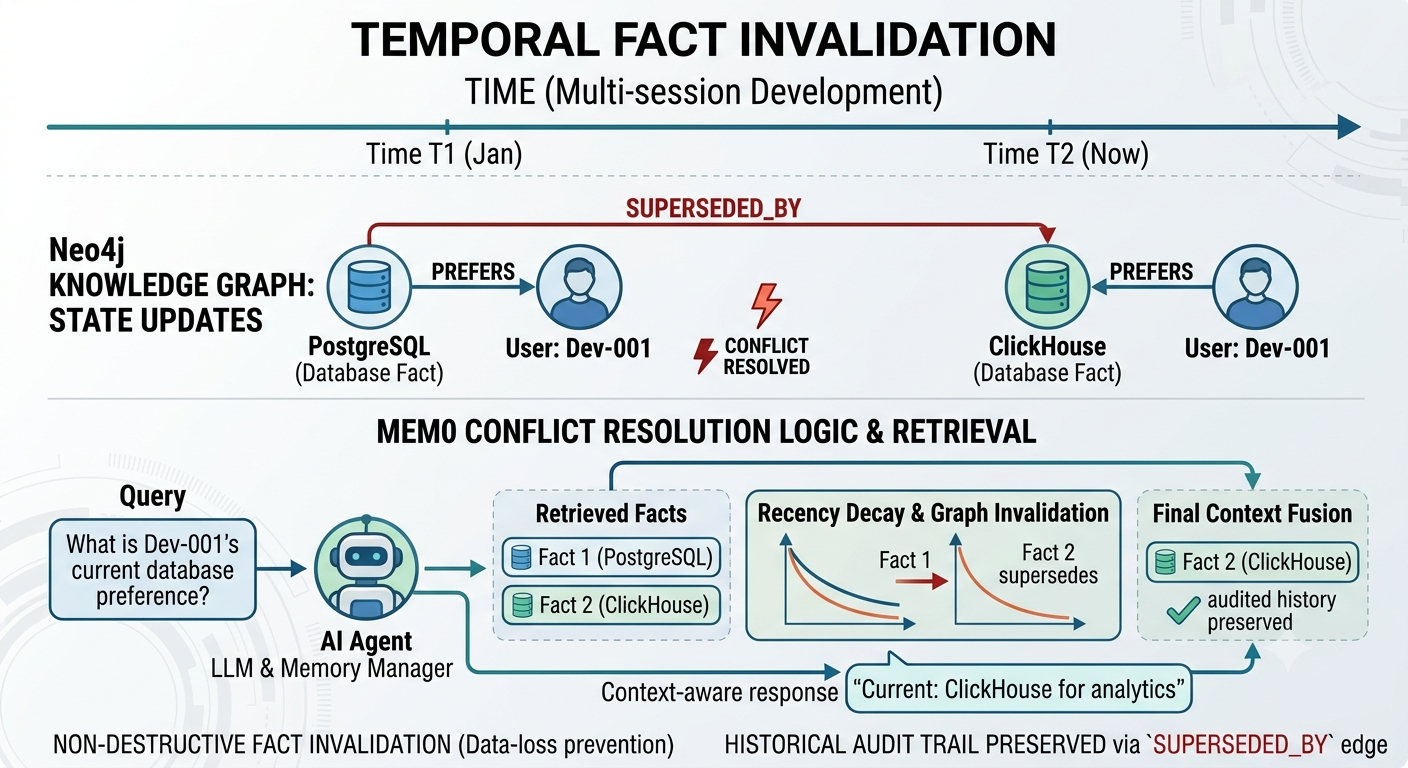
Practical Tips for Production Memory Deployment
- Start vector-only, add graph memory when you need it. Qdrant alone handles the majority of use cases. Only reach for Neo4j when your domain genuinely has entity relationships that need traversal — service dependencies, organizational hierarchies, evolving architectural decisions.
- Never hard-delete memories. Model all contradictions as graph relations (
SUPERSEDED_BY,CONTRADICTS) and let retrieval-time decay do the suppression. The audit trail is free, and you will want it the first time a user asks “wait, what did I say last month about that?” - Fire
add()off the hot path — always. Write latency (200–400ms) is invisible to users when you sequence it correctly: stream the response first, then fire the memory write asynchronously. Blocking the response path waiting for a write is the single most common Mem0 performance mistake. - Use
metadatafilters aggressively at retrieval time. Tag every memory with a category (preference, architecture_rule, debug_decision, sprint_context). Targeted retrieval with a metadata filter is dramatically more precise — and faster — than relying on semantic similarity alone. - Tune decay rate per memory category, not globally. A user’s name should decay slowly or not at all. A user’s “current sprint focus” should decay fast. A single global decay rate will misrank one of them badly. Treat decay rate as a per-category hyperparameter.
- Validate benchmark numbers on your own data before planning capacity. Published LOCOMO accuracy figures vary significantly across judge models, harnesses, and backbone LLMs. Independent reproductions have scored the same nominal system anywhere from the mid-20s to the low-90s depending on evaluation setup. Always run your own eval on your own data distribution before committing infrastructure budget to a headline figure.
Frequently Asked Questions
What is Mem0’s vector graph memory architecture exactly?
It’s a dual-storage memory system that combines a vector index (Qdrant by default) for semantic recall with a knowledge graph (Neo4j) for entity-relationship storage. Instead of injecting the full conversation history into every prompt, Mem0 extracts, stores, and retrieves only the relevant memories — reducing token costs by roughly 85–90% compared to full-context injection, while preserving relational reasoning capability that pure vector search cannot provide.
Do I need both Qdrant and Neo4j to use Mem0?
No. The vector store (Qdrant or any supported alternative) is required and handles most use cases on its own. The graph store (Neo4j) is entirely opt-in. Enable it only when your domain genuinely needs entity-relationship traversal or non-destructive fact invalidation. Start vector-only, profile your retrieval quality, and layer in graph memory when the domain earns it.
How does Mem0 handle changing facts — like switching databases?
When graph memory is enabled, Mem0’s conflict resolver adds a SUPERSEDED_BY edge from the old fact node to the new one instead of deleting the old fact. At retrieval time, a recency decay penalty suppresses the stale fact in the ranking. The historical fact is still queryable for audit — nothing is ever hard-deleted. This is the architectural difference between temporal reasoning and simple deletion.
Is graph-based memory for LLM agents worth the added cost and latency?
It depends entirely on your domain. Graph memory roughly doubles per-query token cost and adds 100–300ms of latency on multi-hop traversals. For flat preference storage or simple conversational agents, it’s overkill. For service-dependency maps, organizational knowledge bases, architectural decision tracking, or any domain where facts evolve and entities relate — the accuracy gain is decisive.
How does Mem0 compare to Neo4j’s own agent-memory library?
Neo4j’s neo4j-agent-memory library (released June 2026) is graph-native with three explicit memory types: short-term conversations, long-term entity knowledge, and reasoning traces. It gives you fine-grained control over each tier. Mem0 takes a higher-level approach — it abstracts the storage tier behind a unified API and handles routing automatically. Neo4j’s library is the right choice when you want full control over graph schema; Mem0 is the right choice when you want faster time-to-integration and a managed API.
What is the LOCOMO benchmark and why does it matter?
LOCOMO (Long-Context Memory benchmark) is a dataset of 1,540 questions across multi-session dialogues — single-hop, multi-hop, temporal, and open-domain categories. It’s the closest thing to a standard evaluation for agent memory systems. Mem0’s published benchmark results show a 91% reduction in p95 latency and a ~26% accuracy improvement over the full-context baseline. That said, independent reproductions show significant variance in the accuracy number — treat it as directional, not definitive.
Can I use Mem0 vector graph memory architecture with LangGraph or PydanticAI?
Yes — Mem0’s AsyncMemory API is framework-agnostic Python async. In PydanticAI you register retrieval as an @agent.tool; in LangGraph you call it inside a node runnable. The retrieval round-trip (query embedding + ANN search + payload filter) typically resolves in 10–50ms, well within the latency budget of both frameworks. The write path is also async, so it slots naturally into background task patterns in both frameworks.
Conclusion
Building AI agents that actually remember — not just within a session, but across weeks of interaction, across architectural pivots, across the entire arc of a project — is one of the genuinely hard problems in production AI engineering. Mem0’s vector graph memory architecture is the most complete open-source answer to that problem available today.
It combines the fuzzy, associative power of vector embeddings with the structured, relational clarity of a knowledge graph. It handles fact invalidation without data loss. It keeps token costs bounded regardless of conversation length. And it plugs into the frameworks you’re already using without requiring a rewrite.
The shift from stateless to stateful AI is not just an engineering upgrade — it’s the difference between a tool you use and a collaborator you trust. Persistent AI agent state is what makes that possible.
If you’re building an agent that needs to remember more than a single session — whether that’s a codebase copilot, a customer service bot, a research assistant, or a personal productivity agent — the hybrid memory architecture pattern is where to start. Begin with vector-only using Qdrant, profile your retrieval quality on real conversations, then layer in Neo4j graph memory when your domain genuinely needs relationship traversal and temporal fact tracking.
The code is open source. The documentation is solid. The benchmark data is available to reproduce. There’s no reason your agent should still be forgetting.