IndiaAI Mission x NVIDIA: Free GPUs for India’s Builders

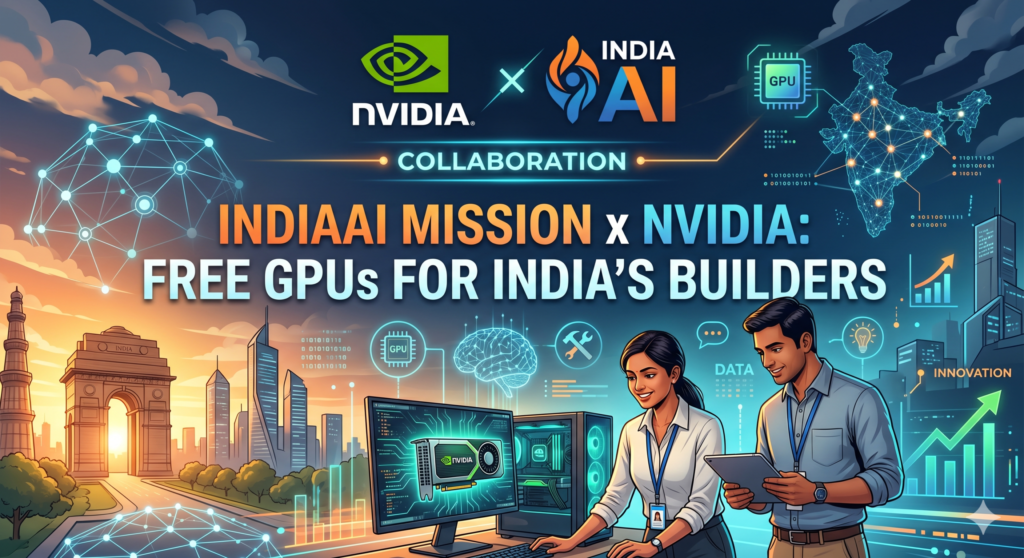
Table of Contents
- What Is the IndiaAI Mission? (The ₹10,371 Crore Plan Explained)
- The NVIDIA Partnership — What’s Actually on the Table?
- What Does This Mean for Indian Students?
- What Does This Mean for Indian Startups?
- The Big Picture — India’s AI Sovereignty Goal
- NVIDIA IndiaAI Mission Benefits: Quick Comparison
- My Experience / Expert Take
- Frequently Asked Questions
- Conclusion
IndiaAI Mission x NVIDIA: Free GPUs, Free Enterprise Software, and a Real Shot for India’s Builders
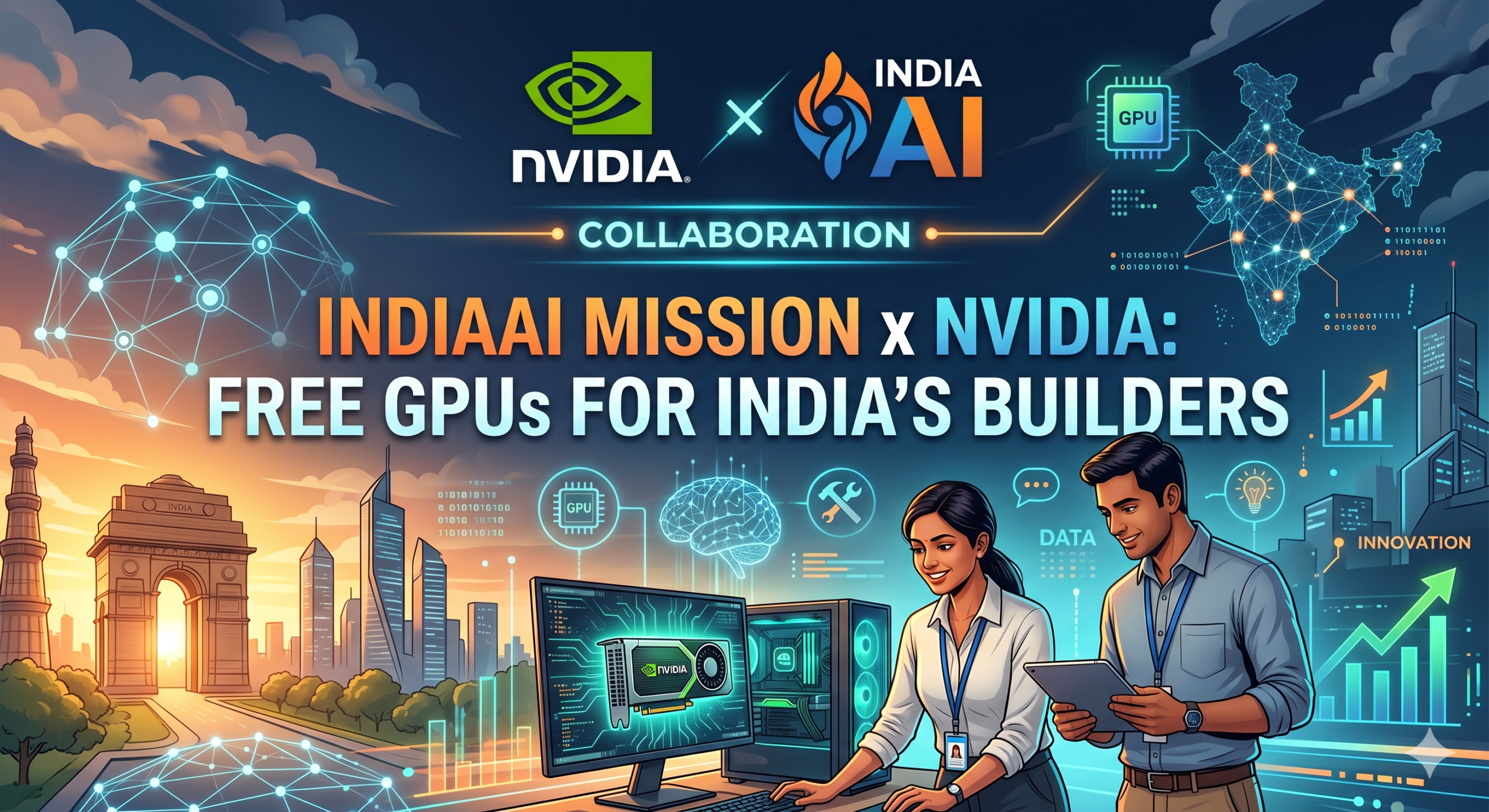
If you’re an Indian student, developer, or startup founder trying to build something serious with AI — and you’ve been staring at AWS GPU pricing in dollars, wondering how you’re supposed to compete — the IndiaAI Mission NVIDIA partnership is probably the most concrete piece of good news the Indian tech ecosystem has seen in years. India now has 38,000 NVIDIA GPUs deployed under a ₹10,371 crore national AI programme. Academic institutions are getting free NVIDIA AI Enterprise software. Over 4,000 Indian startups are already inside NVIDIA’s global Inception program. And NIELIT is setting up AI labs in Tier 2 and Tier 3 cities so that this isn’t just a story about IITs and Bengaluru co-working spaces. Let’s break down exactly what’s happening, who benefits, and — most importantly — what you actually need to do to take advantage of this.
What Is the IndiaAI Mission? (The ₹10,371 Crore Plan Explained)
The Union Cabinet approved the IndiaAI Mission on 7th March 2024, under Prime Minister Narendra Modi. The budget: ₹10,371.92 crore over five years (2024–2029). It’s implemented by the IndiaAI Independent Business Division (IBD) under the Digital India Corporation, and the nodal ministry is MeitY — the Ministry of Electronics and Information Technology.
The mission’s stated vision is “Making AI in India and Making AI Work for India.” That’s not just a slogan. It’s also a direct acknowledgement of a real problem: India has a massive developer talent pool but has historically had to rent compute from US cloud providers at dollar-denominated rates. The IndiaAI Mission is the government’s answer to that structural cost disadvantage.
The 7 Pillars, Briefly
The india ai mission 7 pillars structure is worth knowing, because each pillar maps to a specific benefit — either for you as a student, researcher, or founder:
- IndiaAI Compute — Building GPU clusters (originally 10,000 GPUs; now 38,000 deployed). This gets the most budget: ₹4,563 crore, or 44% of the total outlay.
- IndiaAI Innovation Centre — Developing indigenous large multimodal models trained on Indian data. Budget: ₹1,971 crore.
- IndiaAI Datasets Platform — A unified portal giving Indian startups and researchers access to non-personal public datasets through APIs. Budget: ₹199 crore.
- IndiaAI Application Development Initiative — Funding AI applications sourced from Central Ministries and State Departments. Budget: ₹689 crore.
- IndiaAI FutureSkills — AI courses, fellowships, and Data Labs in Tier 2/3 cities. Budget: ₹882 crore.
- IndiaAI Startup Financing — Risk capital and streamlined funding access for deep-tech AI startups. Budget: ₹1,942 crore.
- Safe & Trusted AI — Responsible AI frameworks, audit tools, and governance guidelines. Budget: ₹20 crore.
India’s Global AI Ranking
Here’s a number that doesn’t get enough attention: as of December 2025, India jumped to #3 on Stanford University’s Global AI Vibrancy Index — up four places in a single year, behind only the US and China. The index measures R&D output, talent availability, responsible AI practices, policy frameworks, and digital infrastructure. India is also the second-largest contributor to AI-related GitHub projects globally, at 19.9% of submissions (just behind the US at 23.4%). These aren’t vanity metrics. They show that the raw human capital is already here. What was missing was the compute.
The IndiaAI Mission NVIDIA Partnership — What’s Actually on the Table?
Most of the major announcements were made at the India AI Impact Summit in New Delhi in February 2026, where NVIDIA unveiled a dense web of partnerships across cloud providers, research bodies, VC firms, and hardware manufacturers. Jensen Huang was expected to attend but pulled out at the last minute. The announcements went ahead without him.
Free NVIDIA AI Enterprise Software for ANRF Institutions
The Anusandhan National Research Foundation (ANRF) is a statutory body under the Indian government that funds AI research across universities and research institutions. NVIDIA has formally partnered with ANRF to give ANRF grantee institutions complimentary access to NVIDIA AI Enterprise software — this includes the full enterprise-grade AI software stack, plus technical mentorship through the NVIDIA AI Technology Center. The collaboration also covers AI bootcamps, workshops, and hackathons at participating institutions.
NVIDIA AI Enterprise is not a free tier you find on any website. It normally costs thousands of dollars per node per year. Getting it free through ANRF is a genuine material benefit for researchers and faculty who were previously working around licensing costs or using hobbled open-source alternatives.
“NVIDIA is collaborating with the Anusandhan National Research Foundation, a statutory body under the Indian government, to spur cutting-edge AI research across the nation’s leading academic institutions. The initiative will support ANRF’s AI for Science & Engineering program and future AI programs.”— NVIDIA Official Blog, February 2026
The 38,000+ GPU Story
The original IndiaAI Compute Pillar target was 10,000 GPUs. India has already exceeded that — with 38,000 GPUs now deployed as of late 2025, according to government data. The key cloud infrastructure being built:
- Yotta’s Shakti Cloud: 20,000+ NVIDIA Blackwell Ultra GPUs, operating across campuses in Navi Mumbai and Greater Noida. Available to enterprises, government customers, and researchers on a pay-per-use basis.
- Larsen & Toubro (L&T): Building gigawatt-scale AI factory infrastructure — 30 MW in Chennai, 40 MW in Mumbai — as part of a landmark partnership with NVIDIA announced at the Summit.
- E2E Networks: Deploying an NVIDIA Blackwell GPU cluster (HGX B200 systems) at the L&T Vyoma Data Center in Chennai, running NVIDIA Enterprise software and Nemotron models for sectors like healthcare, finance, and agriculture.
The explicit purpose of this compute: model training, fine-tuning, and high-scale inference. Capacity is being reserved for model builders, startups, researchers, and enterprises to build Indian AI directly from Indian soil. That’s the indiaai mission free gpu angle made concrete.
Make in India: Netweb Technologies GB200 NVL4
This is the part of the story most people missed in the headlines. Netweb Technologies — an Indian hardware company — is now manufacturing the Tyrone Camarero AI Supercomputing systems based on the NVIDIA Grace Blackwell GB200 NVL4 architecture in India, under the Make in India initiative. Each unit has four Blackwell GPUs and two Grace CPUs, purpose-built for scientific computing, model training, and inference. India is not just buying NVIDIA chips. It’s building systems with them domestically. That’s a different thing entirely.
What Does This Mean for Indian Students? (Real Benefits, Not Just Headlines)
When government schemes get announced, there’s always a gap between the press release and the classroom. I want to be specific here about what’s actually available and what you need to do to access it.
IndiaAI FutureSkills Program
The IndiaAI FutureSkills pillar — with a budget of ₹882 crore — supports 13,500 scholars in total: 8,000 undergraduates, 5,000 postgraduate students, and 500 PhD researchers. These are real fellowships, not just access to a portal. The programme also increased AI courses across UG, PG, and PhD levels at AICTE, NBA, NAAC, and UGC-recognized institutions. Fellowships are now open across disciplines — engineering, medicine, law, commerce, and even liberal arts — not just Computer Science.
The IndiaAI Fellowship Portal is the entry point. Students can apply through the IndiaAI website (indiaai.gov.in). As of mid-2025, over 200 students had already received AI scholarships, with 26 institutes onboarding PhD students into the programme.
For students who want to access “free AI tools for Indian students” — the FutureSkills programme also gives enrolled students access to AI development environments and tools through the computing infrastructure pillar. You don’t need to be at an IIT. That’s the point.
NIELIT Data & AI Labs in Tier 2/3 Cities
This is where things get genuinely interesting for students outside the metro bubble. The first two AI Data Labs were set up at NIELIT’s Delhi centre and ICIT, Nagaland. Since then, 27 NIELIT labs have been identified and made operational across Tier 2 and Tier 3 cities — part of a plan to build a 570-lab network across India. These labs run foundational AI and data courses under the FutureSkills initiative. In February 2026, 30 more AI Data Labs were launched pan-India at the India AI Impact Summit.
States and Union Territories have also nominated 174 ITIs and polytechnics for potential lab expansion. If you’re in a city like Rajkot, Nashik, Coimbatore, or Bhopal — there’s now a real, funded pathway to access AI training that didn’t exist two years ago.
As part of this, the FutureSkills PRIME program under MeitY offers 119 dedicated AI courses. Many are free or heavily subsidized for enrolled students.
What Does This Mean for Indian Startups? (Step-by-Step: How to Benefit)
Let’s not bury the lede: if you’re building an AI startup in India right now and you’re not inside NVIDIA’s Inception program, you’re leaving real value on the table.
How to Apply to the NVIDIA Inception Program India
NVIDIA Inception is a free, no-equity program — no demo day, no cohort, no fixed deadline. As of April 2026, it has 19,000+ member companies globally. Over 4,000 Indian AI startups are already inside it. Here’s what you get and how to get in:
What you get:
- Free NVIDIA Deep Learning Institute (DLI) training credits
- Full SDK access, model libraries, and NVIDIA developer platforms
- Up to $100,000 in AWS Activate cloud credits (via NVIDIA-AWS partnership) — usable directly for NVIDIA GPU instances on EC2
- Up to $150,000 in Nebius AI cloud credits for GPU infrastructure
- Access to NVIDIA’s VC network through Inception Capital Connect
- Preferred pricing on NVIDIA hardware and enterprise software
- Marketing and case study visibility from NVIDIA
Requirements to join:
- At least one developer on the team
- Working website
- Officially incorporated company
- Less than 10 years old
How to apply: Go to nvidia.com/en-us/startups and fill out the application. It’s rolling — no deadline. You can also apply through the Startup India Portal (startupindia.gov.in) which has a direct NVIDIA Inception accelerator listing. Be specific about your AI application and what NVIDIA technology you plan to build on. Applications with vague descriptions get slower responses.
One honest note: the $100K AWS credits are not automatic. Bootstrapped founders typically report getting $10,000–$25,000 in actual credits. The higher tiers kick in when you have institutional funding and demonstrated NVIDIA usage. Still — even $10,000 in GPU credits is significant if you’re in India building on a rupee budget.
The VC Network and Fund of Funds 2.0
Beyond Inception, NVIDIA is now directly co-investing with Indian VC firms to identify and fund AI startups. The confirmed VC partners as of the February 2026 Summit: Peak XV Partners, Elevation Capital, Z47, Accel India, and Nexus Venture Partners. This is important because it means NVIDIA isn’t just offering tools — it’s helping route capital to startups it thinks are worth funding.
NVIDIA also separately teamed up with AI Grants India (co-founded by Vaibhav Domkundwar and Bhasker Kode) to support 10,000+ early-stage founders over the next 12 months. And early-stage firm Activate (backed by Vinod Khosla and Aravind Srinivas among others) is deploying a $75 million fund, with 25–30 AI startups from that fund getting preferential access to NVIDIA’s technical expertise.
On the government side: the IndiaAI Startup Financing Pillar has ₹1,942 crore allocated specifically for deep-tech AI startups. This connects to the broader “artificial intelligence india government” funding architecture, which also includes Fund of Funds programmes and the IndiaAI Startups Global Acceleration Programme — a partnership with Station F and HEC Paris to help Indian startups expand into Europe.
The Big Picture — India’s “india ai mission tenure” and Sovereignty Goal
Here’s the uncomfortable truth about AI infrastructure: for the past five years, any Indian developer who wanted to train a serious model had to log into AWS or Google Cloud, pay in dollars, and watch their compute budget evaporate at whatever the USD/INR exchange rate happened to be that week. A researcher in the US or Europe with the same budget in their local currency had roughly 80–85% more effective compute power. That is a structural disadvantage, and it’s not about skill.
The IndiaAI Mission’s compute pillar is a direct attempt to fix that. By building GPU clusters on Indian soil — denominated in rupees, accessible through Indian cloud platforms — it reduces the dollar dependency for inference and fine-tuning workloads. Training from scratch is still expensive everywhere, but fine-tuning and inference are now within reach for Indian startups that weren’t previously in the game.
The “india ai mission launched in” March 2024 also came with an explicit sovereignty angle: India wants to build its own foundation models on Indian data, in Indian languages. The IndiaAI Innovation Centre is funding exactly this. Four startups were selected in Phase 1: Sarvam AI, Soket AI, Gnani AI, and Gan AI. BharatGen — India’s first government-funded multimodal LLM — supports 22 Indian languages. These models aren’t just academic projects. They’re running on Indian GPU infrastructure and being deployed in real government services.
Is India realistically going to compete with the US and China on foundation model development in the next two years? Probably not at the frontier. But that’s not the point. The point is that Indian AI applications, built on Indian models, running on Indian infrastructure, processing Indian data — don’t need to route through foreign servers. That’s sovereignty in a practical sense, not just a political talking point.
The second-order effects are significant: if Indian startups can now train and deploy models without the dollar cost barrier, the next generation of “indian ai app” products — whether for agriculture, regional language processing, healthcare diagnostics, or government services — becomes commercially viable for markets that global AI companies don’t bother building for. That’s a real competitive moat, not a consolation prize.
NVIDIA IndiaAI Mission Benefits at a Glance
| Who Benefits | What’s Available | How to Access |
|---|---|---|
| UG/PG Students | IndiaAI Fellowship (stipend + tools), NIELIT Data & AI Labs in 27 Tier 2/3 cities, FutureSkills PRIME courses (119 AI courses) | Apply via indiaai.gov.in Fellowship Portal |
| PhD Researchers | 500 PhD fellowships, free NVIDIA AI Enterprise via ANRF, access to bootcamps & workshops | Through ANRF-affiliated institutions + IndiaAI Fellowship |
| AI Startups (early-stage) | NVIDIA Inception (free, no equity): DLI training, SDKs, $10K–$150K cloud credits, VC network access | nvidia.com/en-us/startups (rolling applications) |
| Funded Startups | Peak XV / Accel / Elevation Capital co-investment pipeline, Activate fund (25–30 startups), AI Grants India (10,000 founders) | Through NVIDIA Inception Capital Connect + direct VC outreach |
| Enterprises & Researchers | Access to Yotta Shakti Cloud (20,000+ Blackwell GPUs), E2E Networks TIR platform, L&T AI factories (Chennai/Mumbai) | Pay-per-use via Indian cloud providers |
| All — via indiaai.gov.in | Non-personal datasets via IndiaAI Datasets Platform, foundation model collaborations (BharatGen, Bhashini in 22 languages) | indiaai.gov.in datasets portal |
My Experience / Expert Take
I’ve been watching India’s AI policy space for a few years now, and I’ll be honest: when the IndiaAI Mission was announced in March 2024, I filed it alongside the many government tech initiatives that make good press and mediocre progress. The 10,000 GPU target sounded fine but vague. The 7 pillars looked well-structured but untested.
Two years in, I’m genuinely revising that take.
The numbers have moved. 38,000 GPUs deployed vs. a 10,000 target is not spin — that’s real infrastructure. The L&T-NVIDIA gigawatt-scale factory is not a pilot. And the fact that Netweb Technologies is now manufacturing Grace Blackwell systems in India under Make in India is the kind of supply chain development that takes years to replicate. These are structural changes, not announcements.
What still worries me is the last mile. The NIELIT labs in Tier 2/3 cities are a genuinely good idea — but 27 labs across a country of 1.4 billion people is a start, not a solution. The IndiaAI Fellowship numbers (200 students received scholarships by July 2025) feel thin relative to the scale of the opportunity. The gap between the stated 13,500 fellowship slots and the 200 actually filled is something the programme needs to close quickly.
The startup side is more credible. NVIDIA Inception’s no-equity, no-deadline model is genuinely founder-friendly. The VC co-investment partnerships with Peak XV and Accel are not PR fluff — those firms are serious capital allocators. If you’re building an AI startup in India right now and you haven’t applied to Inception, that’s on you, not the programme.
The sovereignty angle is real but needs realistic expectations. India won’t train GPT-5-level models domestically in the next 24 months. What it can do is build excellent fine-tuned models for Indian languages and Indian use cases on Indian infrastructure — and that’s both more achievable and arguably more valuable for actual Indian users than frontier model development. BharatGen supporting 22 languages matters more to a farmer in Bihar than having another English-language LLM.
Bottom line: the IndiaAI Mission NVIDIA partnership is real, the infrastructure is real, and the opportunities for Indian students and founders are more concrete than anything that existed before March 2024. Whether the government executes the last-mile delivery — especially in Tier 2 and Tier 3 cities — will determine whether this is India’s Sputnik moment or just another ambitious document gathering digital dust.
Frequently Asked Questions
Which is India’s own AI? (What is India’s sovereign AI model?)
India’s own AI initiatives include BharatGen — a government-funded multimodal LLM that supports 22 Indian languages built on domestic datasets — and Bhashini, a multilingual AI platform with over one million downloads and 350+ AI models that lets citizens access digital services in 20 Indian languages. Additionally, startups like Sarvam AI, Soket AI, Gnani AI, and Gan AI were selected in Phase 1 of the IndiaAI Innovation Centre to build indigenous foundation models. These are developed under the artificial intelligence india government framework and run on Indian GPU infrastructure.
How many NVIDIA GPUs does India have under the IndiaAI Mission?
India’s original IndiaAI Compute Pillar targeted 10,000 GPUs. As of late 2025, India has 38,000 GPUs deployed, well ahead of target. Yotta’s Shakti Cloud alone runs 20,000+ NVIDIA Blackwell Ultra GPUs. Additional infrastructure is being built through L&T (Chennai and Mumbai) and E2E Networks, which uses NVIDIA HGX B200 Blackwell systems. This makes it the largest concentrated AI compute build in South Asia. The GPU mission of IndiaAI is to make affordable, pay-per-use GPU compute available to model builders, startups, and researchers from within India.
Who is leading the IndiaAI Mission?
The IndiaAI Mission is led by the IndiaAI Independent Business Division (IBD) under the Digital India Corporation (DIC), which operates under the Ministry of Electronics and Information Technology (MeitY). The mission was approved by the Union Cabinet under Prime Minister Narendra Modi. The nodal ministry responsible for steering it is MeitY. The india ai mission tenure is five years, running from 2024 to 2029.
How can I apply for the NVIDIA Inception program from India?
Go to nvidia.com/en-us/startups and click “Join Inception.” The application is free, rolling (no deadline), and takes no equity. You need to be a registered company (less than 10 years old), have at least one developer, and have a working website. You can also apply through the Startup India Portal (startupindia.gov.in) which lists NVIDIA Inception as an accelerator programme. After joining, you’ll get access to SDKs, DLI training credits, and cloud credit partnerships with AWS and Nebius. The NVIDIA Inception program India already has over 4,000 member startups.
Is the IndiaAI Mission available for students in Tier 2 and Tier 3 cities?
Yes — and this is one of the most deliberate parts of the programme. 27 NIELIT Data & AI Labs have been set up in Tier 2 and Tier 3 cities, with plans to expand to a 570-lab network nationwide. States have also nominated 174 ITIs and polytechnics for potential lab expansion. The IndiaAI FutureSkills fellowships are open to students from AICTE, NBA, NAAC, and UGC-recognized institutions — which includes a large number of colleges outside metro cities. The programme is explicitly designed to “mitigate barriers to entry into AI programmes”, which includes geography. If your city has a NIELIT centre, check whether an AI Data Lab has been set up there at indiaai.gov.in.
Conclusion: India’s AI Window Is Open — What You Do Next Matters
The IndiaAI Mission NVIDIA partnership is not just another government-industry press release. It’s 38,000 GPUs on Indian soil, free enterprise AI software for researchers, 13,500 fellowship slots for students, 4,000+ startups inside a global AI accelerator, and VC firms actively co-investing in Indian AI companies. The infrastructure exists. The funding exists. The ecosystem connections exist. What doesn’t exist is infinite time — the best opportunities in programmes like Inception go to the founders who move first.
Here’s what you should do right now: if you’re a student, check the IndiaAI Fellowship Portal at indiaai.gov.in and see if your institution qualifies. If you’re a startup founder, apply to NVIDIA Inception today at nvidia.com/en-us/startups — it takes 30 minutes and costs nothing. If you’re a researcher, ask your institution whether they’re an ANRF grantee and how to access NVIDIA AI Enterprise. India’s AI moment is here. Don’t be the person who read about it in 2026 and wished they’d acted.
Published on TechGVS | Follow IndiaAI Mission updates at indiaai.gov.in | Sources: NVIDIA Blog, PIB, Stanford HAI, TechCrunch, Business Standard, DD News